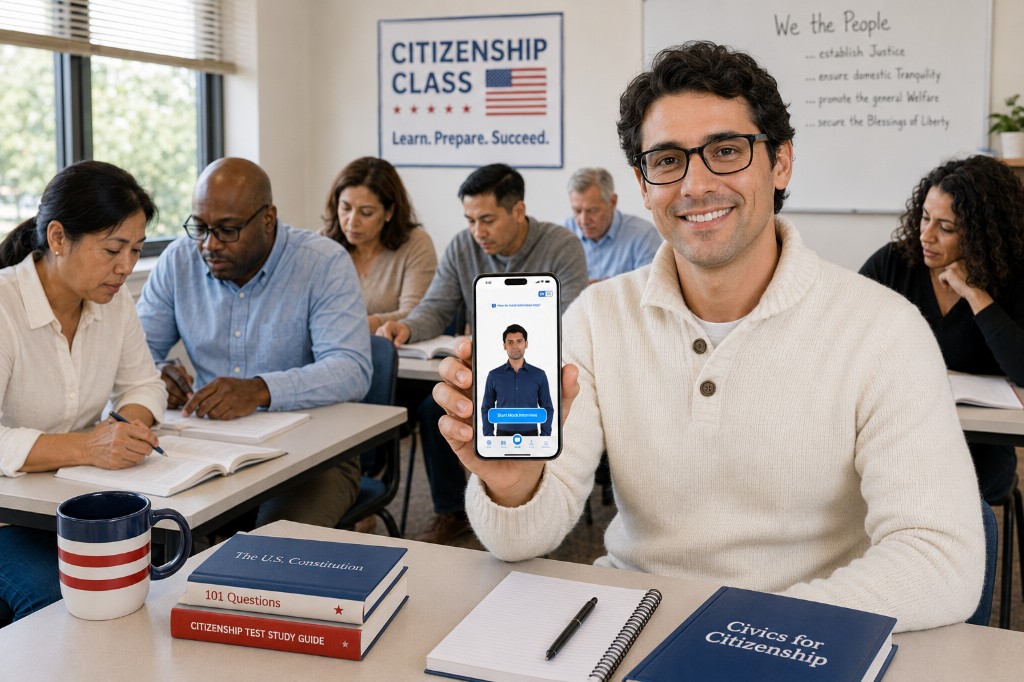
If you're preparing for the US citizenship test, you may be wondering whether to take a citizenship class, use a study app, or both. The truth is that classes and apps serve different needs, and many applicants get the best results by combining them. Here's how they compare.
Quick Verdict
Both are valuable, and they work best together. Citizenship classes give you community, live teachers, and study partners. Citizenry gives you 24/7 mock interviews and the only premium bilingual audiobook in this comparison, with captions, full timeline scrubbing, and adjustable speeds.
Feature Comparison
Key Differences Explained
Community and Emotional Support
This is where citizenship classes stand out. When you attend a class, you meet other people preparing for the same test. You can share practical tips, encourage each other through the process, and find study partners who are willing to quiz you and go through practice questions together. The emotional support of preparing alongside others who understand exactly what you're going through is valuable.
You can also ask teachers in-depth questions about civics and US history, the kind that go beyond what's on the test but help you understand the material. A good teacher can explain why something matters, not just what the correct answer is.
Availability and Flexibility
Citizenship classes meet on a fixed schedule, and you have to commit to those times. For people who work multiple jobs, care for children, or juggle unpredictable schedules, this can be difficult. If you miss a class, you miss that material.
An app like Citizenry is available 24/7. You can study whenever you have a free moment: 10 minutes on a lunch break, 15 minutes before bed, or during your commute. You study on your schedule, not someone else's.
Mock Interview Practice
The citizenship test is an oral interview. A USCIS officer asks questions and you answer out loud, with no multiple-choice options. This makes practicing the interview format one of the most important things you can do.
In a class, you might practice with a study partner or teacher, but this is limited by class time and the teacher's availability. With Citizenry, you get unlimited mock interviews with virtual USCIS agents. Every interview simulation is unique, so you will never have the exact same mock interview twice. You can choose from multiple agents in both English and Spanish. The AI agents give you feedback, but they will never judge you. You can practice as much as you want, as often as you want, until you feel 100% confident.
Premium Audiobook and Study Materials
Both citizenship classes and Citizenry will provide you with the official USCIS study content. Classes typically hand out printed study guides and go through the civics questions in group sessions.
Citizenry is the only option in this comparison with a premium bilingual audiobook. Listen in English or Spanish, follow along with captions, scrub to any point in the audiobook, and adjust the playback speed. This polished experience makes it easy to continue studying while commuting, doing chores, or exercising.
Language Support
Citizenship classes are usually taught in English, and sometimes in Spanish. If your primary language is Vietnamese, Chinese, Korean, Tagalog, Arabic, or another language, finding a class in your language can be very difficult.
Citizenry supports 20 languages. You can study the civics content in your preferred language while also practicing your English skills, all within the same app.
Cost and Accessibility
Many citizenship classes are offered free through public libraries, community colleges, and nonprofit organizations, which is a real benefit. However, availability depends entirely on where you live. If you're in a rural area or a city without nearby programs, you may not have access to a class at all.
Citizenry is free to download and works anywhere you have a phone. The free iOS version may show recommendations for other apps. Citizenry Pro, available by subscription or lifetime purchase, removes ads and unlocks unlimited mock interviews with virtual USCIS agents.
Pacing and Personalization
In a class, everyone moves at the same pace. If you already know a topic well, you still sit through it. If you need more time on a difficult section, the class may move on before you feel ready.
With Citizenry, you control the pace. Spend more time on the questions you find hardest, skip the ones you already know, and revisit topics whenever you want.
Privacy and Comfort
Some people feel self-conscious about making mistakes in front of others, especially when speaking English or answering civics questions they're unsure about. In a classroom, this pressure is real.
With Citizenry, you practice privately. The AI agents give you feedback and encouragement, but they never judge you. You can get answers wrong a hundred times and no one will know. This privacy can actually help you learn faster because you're not afraid to make mistakes.
Consistency
The quality of a citizenship class depends on the teacher, the curriculum, and the program. Some classes are excellent; others may be less structured. If your teacher is absent or the program ends, your preparation is interrupted.
Citizenry delivers the same high-quality experience every time you open the app. The content is always current with the latest civics test questions and updated political information.
Who Should Choose Each?
Take citizenship classes if you:
- Want to meet other people going through the same process
- Learn better with in-person instruction and group discussion
- Want to ask a live teacher in-depth questions about civics and history
- Have a class available near you that fits your schedule
Use Citizenry if you:
- Need a flexible schedule to study anytime, anywhere
- Want unlimited mock interview practice with virtual USCIS agents
- Prefer to study in a language other than English (20 supported)
- Feel more comfortable practicing privately without others watching
- Don't have citizenship classes available near you
Use both together if you:
- Want the strongest possible preparation for your citizenship test
- Want community support AND unlimited daily mock interview practice
- Want to study with a class on weekends and review with the app during the week
The Bottom Line
Citizenship classes and Citizenry complement each other. Classes provide community, teacher guidance, and study partners. Citizenry adds unlimited mock interview practice at any hour, quizzes in 20 languages, private practice, and a premium English–Spanish audiobook with captions, full timeline scrubbing, and adjustable speeds.
If you can do both, do both. If you have to choose one, think about what you need most: community and live instruction, or flexibility and daily mock interview practice.

Ready to Start Practicing?
Download Citizenry and start your path to citizenship today.