
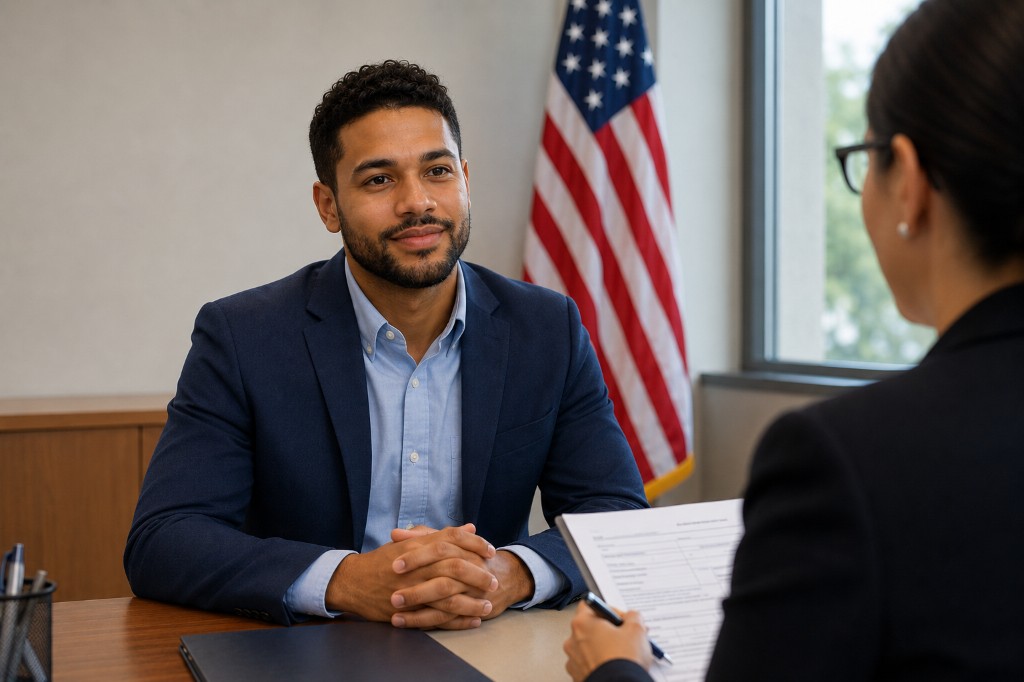
USCIS does not publish a typical length for the citizenship interview. The time varies with the questions the officer needs to cover, any follow-up, and whether you use an interpreter. During the appointment, the officer reviews your Form N-400, judges your spoken English during that review, and gives the reading, writing, and civics tests. The time you spend at the office also includes check-in and waiting.
How the Time Breaks Down
The USCIS Policy Manual sets rules for when each part ends. Those rules explain why many interviews are short.
| Part | What happens | When it ends |
|---|---|---|
| Oath and N-400 review | The officer places you under oath and goes through your application | When the officer has covered your eligibility questions |
| Speaking | Judged from your answers during the N-400 review | No separate time block |
| Reading | Read one of three sentences aloud | After your first correct sentence |
| Writing | Write one of three dictated sentences | After your first correct sentence |
| Civics, 2025 test | Up to 20 oral questions | At 12 correct or 9 incorrect answers |
| Civics, 2008 test | Up to 10 oral questions | At 6 correct or 5 incorrect answers |
If you pass every section on the first try, you answer as few as 12 civics questions on the 2025 test, one reading sentence, and one writing sentence.
What May Reduce Follow-Up
Consistent answers and complete documents can reduce follow-up questions, but they do not guarantee a shorter appointment. Applicants who qualify for an exception to the English test skip the reading and writing sections, as the USCIS exceptions page explains.
What Can Add Time?
The Policy Manual says the officer asks follow-up questions to resolve outstanding issues, including answers that conflict with your N-400 or the evidence. Situations that often lead to follow-up questions include:
- Differences between your N-400 and your documents
- Long trips outside the United States
- Arrests, citations, or other criminal history
- Tax or child support issues
- Changes since you filed, such as a new address, job, or marriage
- Questions the officer needs to repeat or rephrase
An interpreter also adds time, because each question and answer is translated. Applicants who qualify for an English exception must bring their own interpreter, and the interpreter signs Form G-1256 with you in front of the officer. If you have a change to report, our guide on correcting your N-400 at the interview explains what to bring.
Wait Time at the USCIS Office
The wait before your interview can take longer than the interview itself. Arrive at the time your interview notice gives, and bring the documents it lists in an organized folder. The Form N-400 instructions say USCIS may also take your biometrics at the interview to confirm your identity and update background checks.
What Happens After the Interview?
The Policy Manual says the officer must give you a written results notice, Form N-652, at the end of the interview, whatever the outcome. The officer can:
- Approve your application, after which USCIS schedules your oath ceremony
- Continue your case, for example by requesting evidence with a deadline listed in the notice or scheduling a retest 60 to 90 days later
- Deny your application with a written notice that explains how to request a hearing
USCIS has 120 days from the interview to make a decision. Our guide on how long USCIS takes to decide after the interview covers each outcome.
Before Your Appointment
Review your N-400 and bring documents for anything that changed since you filed. Practice civics questions out loud. Citizenry's mock interviews cover the N-400 review, English test, and civics test.
Official Sources
Sources last checked .
- USCIS: N-400, Application for Naturalization
- USCIS: Policy Manual, Volume 12, Part E, Chapter 2: English and Civics Testing
- USCIS: Exceptions and Accommodations
- USCIS: Policy Manual, Volume 12, Part B, Chapter 3: Naturalization Examination
- USCIS: Instructions for Form N-400 (edition 01/20/25, PDF)
- USCIS: Policy Manual, Volume 12, Part B, Chapter 4: Results of the Naturalization Examination
Related Articles
- How to Prepare for the N-400 Interview
- What to Bring to Your Citizenship Interview
- Citizenship Interview Questions: What USCIS May Ask
- What to Wear to Your US Citizenship Interview

Practice with Citizenry
Answer interview questions out loud and get feedback in the app.